18 Which of the Following Is Not a Convergent Boundary
Ocean trench volcanic island arc earthquakes. As a tectonics plates moves over a hot spot a string of volcanoes forms.
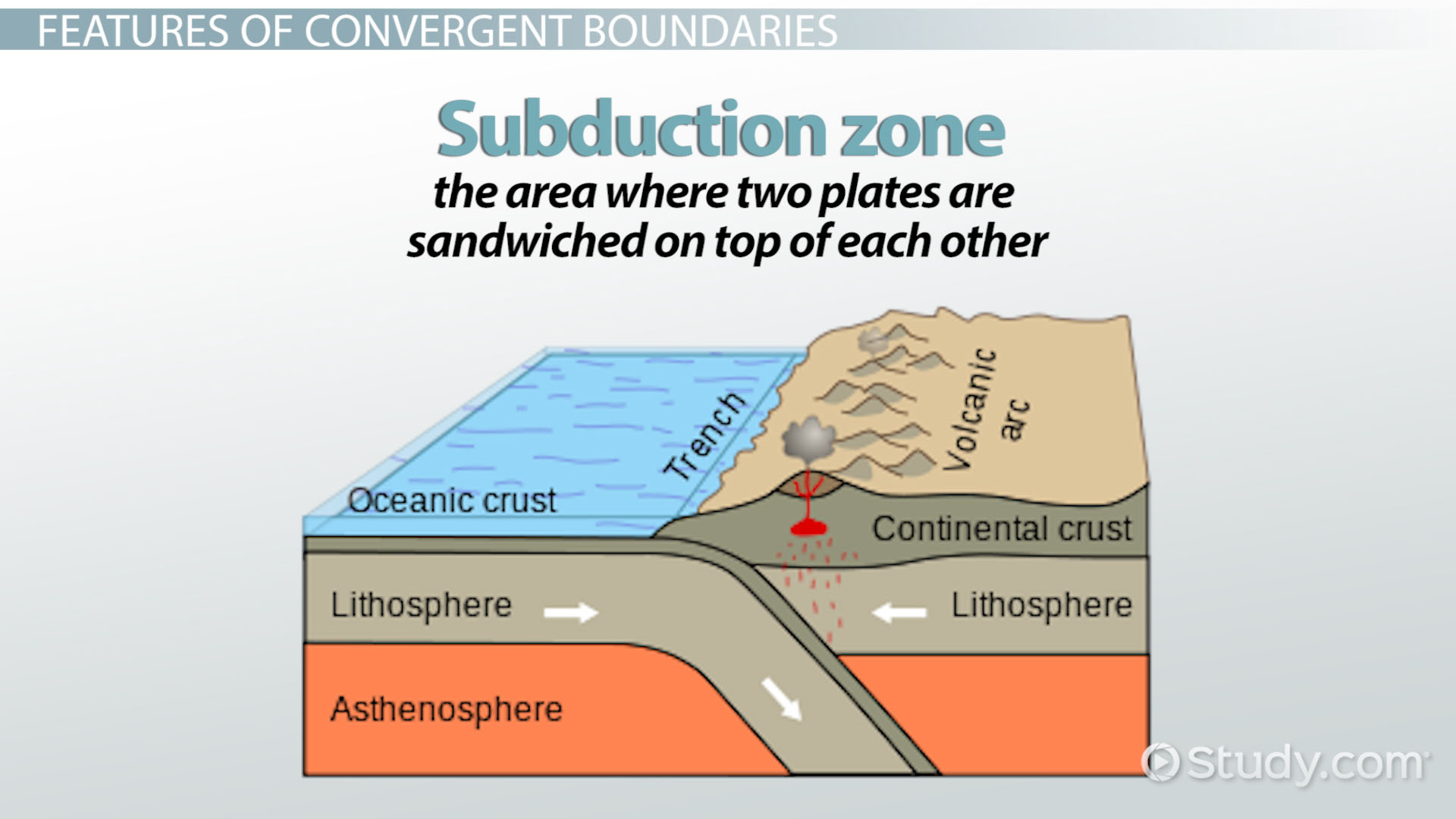
Convergent Boundary Definition Facts Examples Video Lesson Transcript Study Com
Convergent boundaries can occur between oceanic and.

. Magma forms when rocks begin to melt. As the plates move past each other they sometimes get caught and pressure builds up. The three types of convergent boundaries include.
Oceanic crust is pushed down into the mantle. The driving force of plate tectonics is. One continental plate moves into an oceanic plate.
The condition of equilibrium that results in the displacement of the mantle by the continental and oceanic crust is known as A. A convergent plate boundary is where two plates collide. The first type of boundary discussed in this lesson is a convergent plate boundary.
Continental-volcanic IS NOT a convergent boundary Option D. The landscapes of many National Park Service sites show convergent plate boundary processes that result in a variety of mountain ranges and complex geological structures characteristic of subduction zones accreted terranes and collisional mountain ranges. On the oceanic side of the trench On the continental side of the trench.
38 Which of the following is NOT associated with a convergent plate boundary. Geothermal energy resources are concentrated in areas near earth surface that either have a lot of shallow magma or are ____. Which of the following features would you expect to find at an ocean-ocean convergent boundary.
Label the diagrams as composite volcano cinder-cone volcano or shield volcano. One oceanic plate moves into another oceanic plate. Which of the following would you expect to find at a continent-continent convergent boundary.
The leading edges of both plates are bent downward. Crust being neither created nor destroyed and shearing motion B. Oceanic-Continental convergent boundaries which occur when a continental plate and oceanic plate collide eg the Nazca Plate under South America.
A Accretionary prism B Volcanic arc C Subduction zone D Rift valleys E Earthquakes 39 Abyssal plains are formed by. This is an earthquake. A Convergent boundary b Divergent boundaryc Active Margin d Passive margin 19.
Forms when small pieces of magma are ejected into the air then fall back to Earth and pile up around a vent. Earthquakes O trenches rifts volcanoes Question 19 2 pts When a trench is located next to a continent where would you expect to find active volcanoes. The _______________ are the result of a hot spot.
New York City has no major earthquakes because it is in which of the following geological settings. Most seismic activity occurs at three types of plate boundariesdivergent convergent and transform. Convergent boundaries are the borders between the plates that are moving towards each other and colliding.
Crust and upper mantel. The lithosphere consists of ________________. When the plates finally give and slip due to the increased pressure energy is released as seismic waves causing the ground to shake.
Which of the following is NOT a geologic process that occurs along convergent boundaries. Magma is a mixture of molten rock suspended minerals and gases. Letters in ovals are codes for NPS sites at modern and ancient convergent plate boundaries.
What characteristic of magma controls how. Has broad gently sloping sides and a nearly circular base. Aearthquakess Brift valleys Cisland arcs Ddeep-sea trench.
A convergent plate boundary occurs where two plates push against each other. Question 6 of 25 40 40 Points Which characteristics describe convergent boundaries. The movement is measured using _____ and the more traditional method of _____.
Pressure decreases with depth below Earths surface. Measuring the age and the distance of sediments from the oceanic ridge. The oceanic plate sinks beneath the continental plate forming a subduction zone over the oceanic plate.
What method do geologists use to determine the absolute age of a rock. A geologist finds a fossil in a layer of sedimentary rock that lies in between two igneous extrusions. How could the geologist determine the age of the fossil.
Deep sea trenches the destruction of seafloor crust and subduction C. The correct answer to your question would. When this happens one plate usually subducts beneath the other plate and in the case of.
Which of the following is not associated with convergent plate boundary. Plates moving apart the creation of new seafloor and the Mid Ocean Ridge. A slow accumulation of pelagic sediment.
Which of the following does NOT occur at a convergent boundary. Question 18 2 pts Which of the following is not associated with convergent plate boundaries. Continental-volcanic is not a convergent boundary.
Why is it difficult to determine the absolute age of a sedimentary rock. A Tidal forces b Centrifugal forces c Nuclear fissiond Convection currents 20. Thus the following convergent boundaries occur when two plates meet.
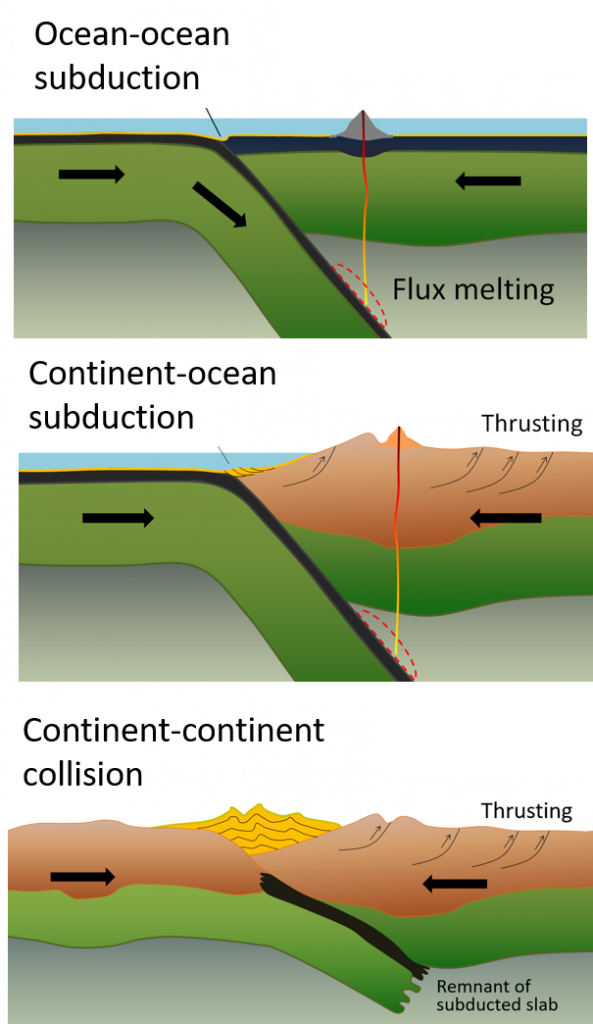
Motion At Plate Boundaries Physical Geology Laboratory

Three Types Of Convergent Plate Boundaries Youtube
File Continental Continental Destructive Plate Boundary Svg Wikipedia

Types Of Plate Boundaries There Are Four Types
Comments
Post a Comment